
Find Town of Ithaca Previous Residents
Past residents of the Town of Ithaca leave a trail that is part paper and part digital. Start from the verified Town situs first. County land records establish a recorded transfer. A library directory's street section prints the household at the address for its year. Federal census records open on a 72-year schedule. Maps prove street and building continuity, permits trace projects, and the table keeps each role separate when asking who lived in a Town of Ithaca house before you.
| Source | Years it covers | Where held | What it can show |
|---|---|---|---|
| County land records | Described as 1817 to present; full online range is not stated. | Tompkins County Clerk, online portal, office records, deed books, and microfilm. | Recorded transfers, parties, instrument dates, and legal descriptions. |
| Clerk office search | 1968 forward at the stated search rate; earlier work is priced by name and two-year period. | County Clerk Land Services. | A specified historical land search when an online result stops. |
| Ithaca directories | Listed runs begin in 1864 and extend through 1986, with physical holdings described as potentially reaching 2000. | Tompkins County Public Library digitized material and local-history holdings. | Dated street number, person, business, household notation, or vacancy. |
| Federal census | Released under the 72-year rule; the 1950 Census is available. | NARA and library research databases. | Dated household and locality evidence. |
| Town permit records | Current and closed specified records; public documents often have a pre-2022 gap. | Town OpenGov, Code Enforcement, and Town FOIL. | Project, permit, certificate, or code-event history. |
Label each clue by its source. A directory or census name was "listed at" the address for that source year. A deed party was an owner or transfer party, and that distinction keeps an Ithaca house history honest when the sources conflict.
Anchor Town of Ithaca Past Residents
Confirm the address sits in the Town rather than the City or another Ithaca-area municipality. ZIP 14850 crosses municipal lines. The Town's address verifier is the first stop. County Address Lookup returns the official address, ZIP code, and municipality for the parcel. Keep the parcel or Printkey, the situs, the map date, and any unit text. A postal city name never substitutes for that municipal result.
Assessment rolls are dated snapshots. Read each one as an owner, mailing-address, and situs relation for a single year. Tompkins County Assessment Beacon is built to show ownership, assessment detail, sketches, and tax maps. Access requires payment. County Assessment at 607-274-5517 is the parcel-card fallback. The county tax-map page supplies map material. Paid-tax questions belong with the town clerk or the school district.
Trace Town of Ithaca Previous Owner Chains
The deed chain is the backbone of a Town of Ithaca previous residents search. It records ownership, not occupancy. Start with the parcel and current owner. The Clerk's publicsearch.us platform offers two search routes. Advanced Search accepts party names, grantor, grantee, Parcel Id, City, recorded-date ranges, document types, document numbers, book, volume, page, and document-image phrases. Not every older instrument is online. Record your exact stopping point, and ask the Clerk about the next access channel for deeper records.
- Confirm the Town situs and parcel or Printkey in County GIS or through Assessment.
- Read the current owner and mailing relation only as dated assessment evidence, then search that owner as a grantee.
- Open the purchase instrument when available, retain its date and legal description, and name the seller as the grantor.
- Search that seller as a prior grantee and compare the earlier legal description before continuing backward.
- When the online path ends, use the Clerk office, phone, email, specified search, deed books, or microfilm rather than assuming the chain ended.
- Grantor
- The person or entity that transfers an interest in a recorded instrument.
- Grantee
- The person or entity receiving that recorded interest.
- Chain of title
- The linked sequence of recorded transfers for the same legal parcel or interest.
- Legal description
- The land description in a deed or plat. It is more stable than a street number when roads, lots, or addresses change.
Use County Clerk Advanced Search for a backward deed chain.
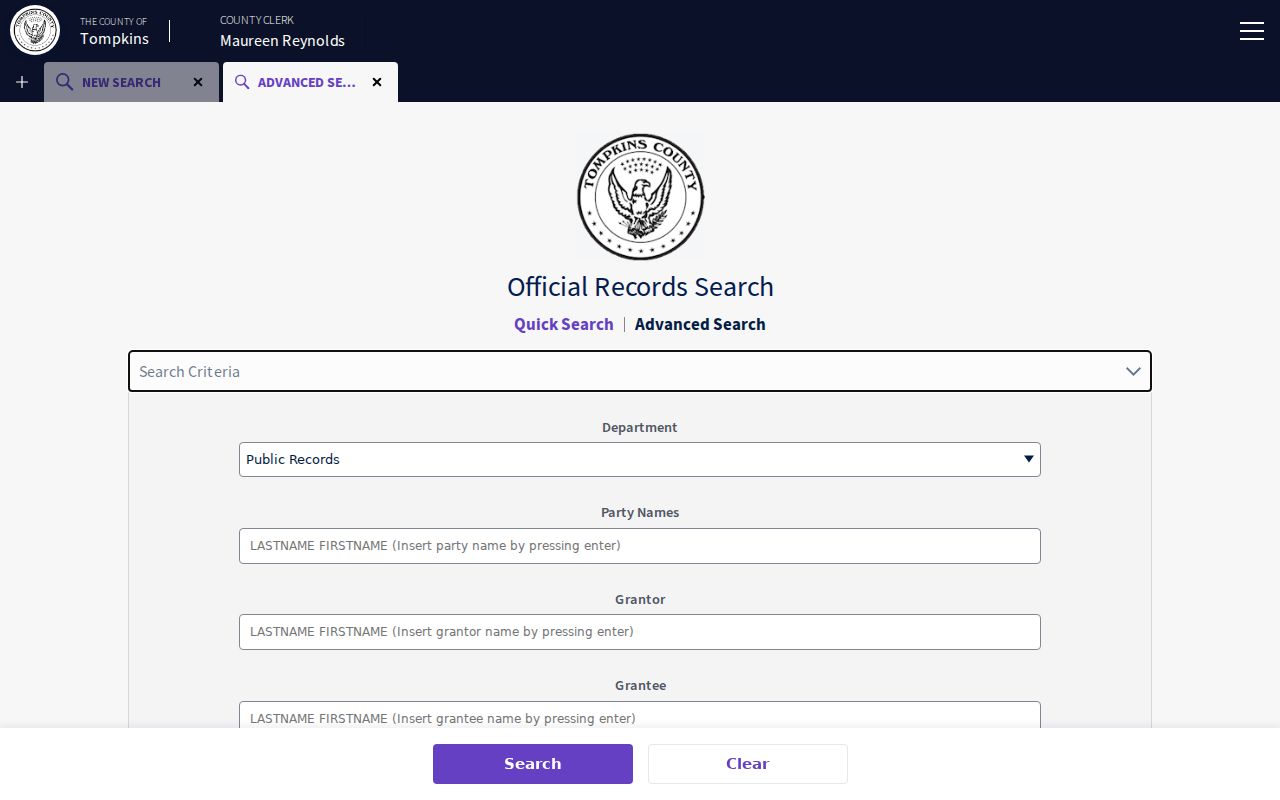
The image highlights the advanced-search route. It does not prove older images are online. Note your exact stopping point, then ask the County Clerk for the next access channel.
Check Town of Ithaca Previous Records Gaps
Quick Search works once a party, subdivision, document type, or document number is already known. Optional date filters and recent recorded-date shortcuts narrow results. Choose Index Only or Index and Full Text OCR. Partial names take an asterisk. Two or more words behave differently in the Index Only and OCR modes. Test any phrase carefully.
Start with the County Clerk Quick Search for the general index route before narrowing into Advanced Search.
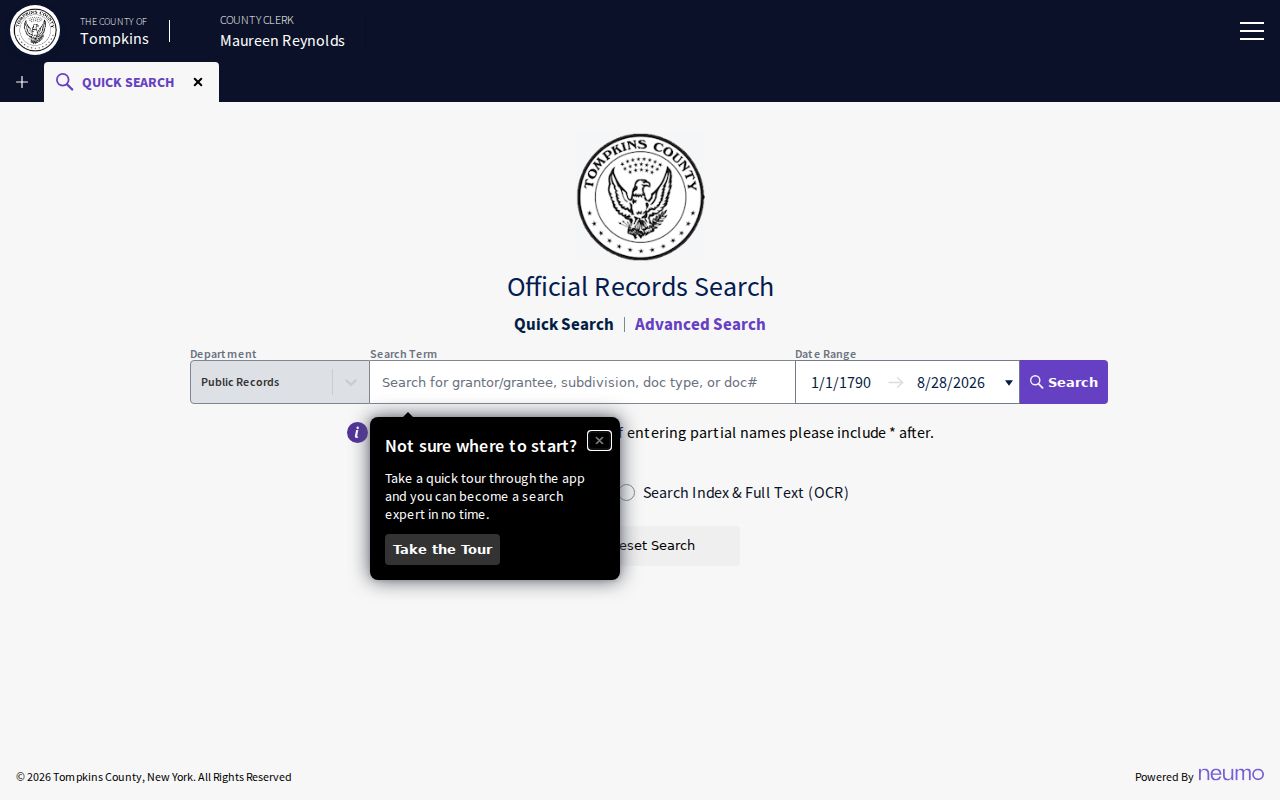
The quick-search controls do not publish complete historical online coverage. County genealogy material describes land records from 1817 onward, and the office search route reaches back to 1968 at the stated fee, but the portal does not state a universal online start year.
Contact Tompkins County Clerk Land Services at 320 N Tioga Street, 607-274-5431 for a specified search. The captured fee schedule lists $5 per name for land records back to 1968, $5 for every two years per name before 1968, copies at $0.65 per page with a $1.30 minimum, and $5 certification. Because fee pages can change, confirm the current schedule before ordering.
Pair Town of Ithaca Previous Directory Years
Directories add the household layer that deeds never carry. The library's 1951 business and street material and its 1960 street section organize entries by printed house number. Entries list people, businesses, institutions, households, even vacancies. Start at the number. Read the lines around it. Record the cross streets and the page, then check the alphabetic section for that same year. Each notation key belongs to its own volume.
One dated trail works well: directory street line, alphabetic entry, next directory year, released census year, map footprint, then a deed or obituary clue. The 1950 Census is open. The NARA directory reference identifies Ithaca directories for 1929 through 1931. A move, a renumbered street, or a vacancy can break the line. Describe the interruption rather than forcing continuity. The Town of Ithaca city directories collection holds the fuller catalog and collection context.
Use Town of Ithaca Previous History Sources
Tompkins County Public Library carries most of the local-history load for the Town of Ithaca. Its collections include directories, maps, and newspapers. HeritageQuest works with a library card, and Ancestry Library Edition is available in the building. The local-history room sits at 101 E Green Street. Call 607-272-4557 before you go. Hours run Monday through Thursday 9 to 8 and Friday 9 to 6. Saturday hours are 11 to 5, and the room is closed Sunday. Tell staff the exact year and collection you want. A single directory is never a complete Town list. For weaving people, places, census pages, directories, and maps together, HistoryForge adds address suggestions and map-year navigation.
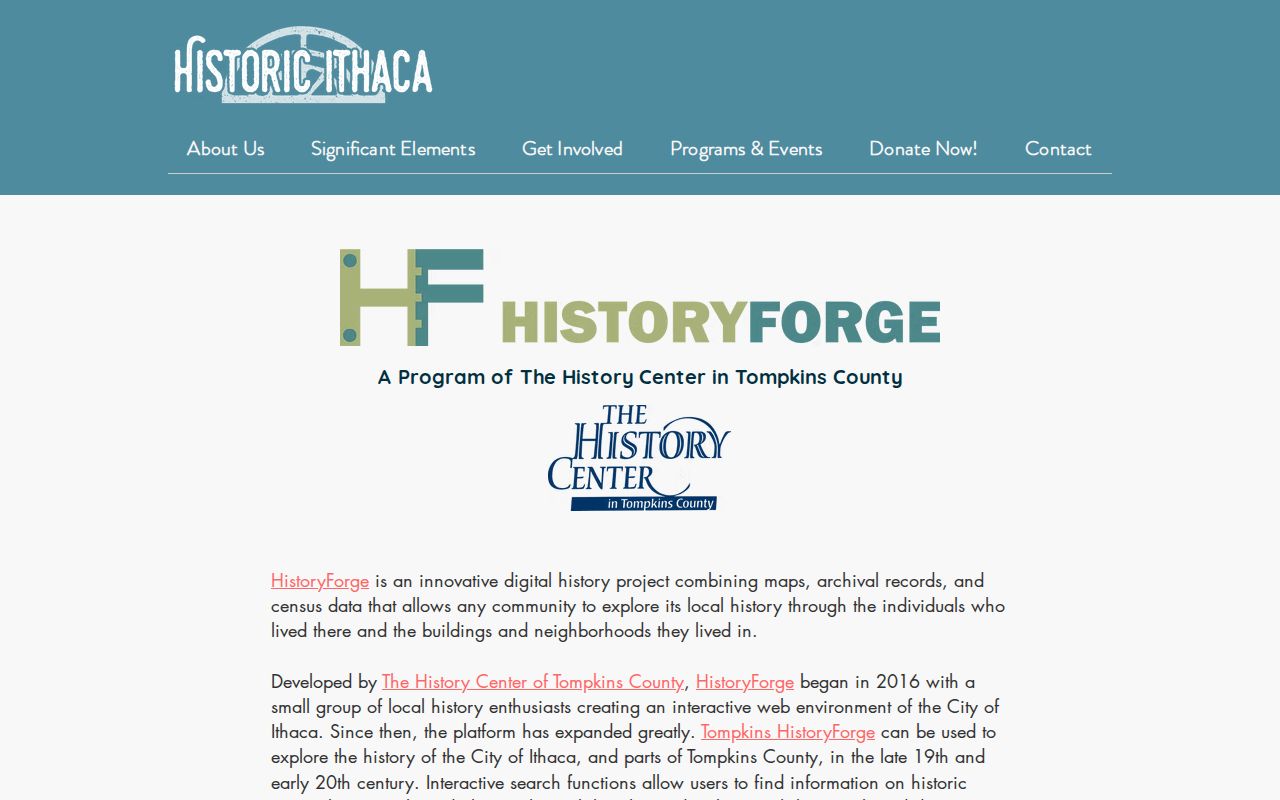
Treat any search screen as historical research, not proof of who lives in a household now. The map coverage runs deep but old. City maps span 1806 to 1933, and County-town maps cover 1853 to 1940, so boundaries and place labels from those eras need careful reading. The History Center takes appointments and reports family genealogy files, oral histories, ledgers, scrapbooks, maps, newspapers back to 1819, photographs, obituaries, cemetery listings, and directories. Email archives@thehistorycenter.net. You can also call 607-273-8284 ext. 2. Confirm the current appointment, fee, and location details, and verify the archive's physical address, before you plan a visit.
Map Town of Ithaca Previous Address Changes
Sanborn and local map layers answer a different question than a residents directory can: did the building footprint and lot relationship survive a street-name change? Confirmed Ithaca map years include 1888, 1898, 1904, 1910, and 1919, and an inventory describes an 1888 to 1961 span. A map can show a footprint, lot, use label, cross street, and an old street name. It cannot name everyone who lived at an address.
Street names shift more than people expect. Floral Avenue began as Humboldt Street, was briefly proposed as Enfield Road in April 1923, and only then became Floral Avenue. Giles Street appeared as Creek Road on an 1836 map and was built in 1855. Search every one of those names. Compare cross streets and parcel shape. Then read the legal description. [INSIDER TIP] An exact modern street string can hide a real earlier record in past residents of Town of Ithaca research, so older names often open the door the current ones close.
Request Town of Ithaca Previous Records
Town OpenGov public search can locate selected active and closed permit records by address through its Locations or Records tabs. Its guide says documents from before 2022 are often absent. For a missing permit, certificate, correspondence set, or inspection record, contact Code Enforcement at 607-273-1783 or use the Town Clerk's public-records route. The Town Clerk serves as Records Management Officer and FOIL contact.
New York's Freedom of Information Law sits in Public Officers Law Article 6, §§84 to 90. The Town accepts a reasonably described request through OpenGov, email, or verbally, and states a five-day response or acknowledgement timeline. An OpenGov account is not required; email or verbal access through the Town Clerk works as an alternative. Name the situs, record type, date range, and a preference for electronic copies.
Close Town of Ithaca Previous Resident Trails
Some trails only close through death and court records. Obituaries, cemetery listings, newspaper notices, and probate files can finish a historical search. The residents directory runs dry at that point. An obituary may name kin or a former address. Probate can surface an heir, fiduciary, or estate role. Neither proves anyone still lived at a particular Town of Ithaca address. Log the role, date, publication or court source, and any conflict with the deed or directory line.
One myth deserves a direct challenge. A historical owner and a historical occupant are not necessarily the same person. An absentee owner, an estate, an institution, a company, a mail recipient, a directory subject, and a permit applicant can all appear in one address history. State your confidence plainly. Phrases like "recorded as owner," "listed at," or "appeared in a map-year record" keep each claim honest.
Respect Town of Ithaca Past Residents
House history works best when every claim stays tied to its time and its source. It is never a license to expose a living person's routine. It must not locate protected people. It must not turn a dated record into a current profile. Household members, protected voters, and Address Confidentiality Program participants do not belong in any public historical directory. The same goes for utility customers, DMV addresses, sealed records, and people with no public role in a parcel record. Respect the line. The past residents record you can cite is not the person you can track.
Lawful use. Use Town of Ithaca past-residents records for family history, estate questions, property history, or local research. Do not use an address trail to watch, stalk, harass, intimidate, or harm anyone.