
Town of Ithaca Resident Lookup Coverage
A Town of Ithaca resident lookup works by comparing record roles. You are not just collecting names. County assessment and parcel material can show a dated owner. It can also give a situs address and a mailing relation. Recorded instruments name the parties and describe the land. A voter match confirms one registration under that tool's rules. Court systems show a party role or a case date where public. Vital records and historical sources can supply an event, a kinship, or a dated listing. Not one of these records alone proves someone lives at an address today.
| Record | What It Confirms | Where | Access |
|---|---|---|---|
| Assessment and parcel | Dated owner, situs, mailing-address relation | Tompkins Assessment and Beacon | County portal target and assessment-office fallback |
| Recorded land index | Instrument parties, dates, and legal-description trail | County Clerk Public Records Search | Online, counter, phone, mail, or email route |
| Voter registration | Matched registration and poll-site relation | NYS Voter Lookup | Individual lookup subject to eligibility and protections |
| Court or probate index | Public party role, case type, dates, or estate relation | Town Justice Court and NY eCourts routes | Online index, public terminal, or clerk file route |
| Vital or history source | Event, kinship, or dated historical listing | NYSDOH, TCPL, and local collections | Eligibility rules or collection access apply |
Start with the record closest to the fact already known. A verified address can lead you to a parcel. A full name with a birth date supports the voter route. A date or a kin relationship narrows a probate or historical search nicely. Before combining any result with another, label it with its record date and its source.
Town of Ithaca Voter Lookup
The individual New York voter lookup is a one-person registration and poll-site tool. It is not a Town-wide name list. All five controls must be filled. The user selects Tompkins County. Then the user enters a last name, first name, date of birth, and ZIP code. JavaScript and cookies are required. The service notes the person must be a registered New York voter. A failed match does not mean the person lives outside Town of Ithaca.
| County | Required dropdown. Select Tompkins for a Town of Ithaca search. |
|---|---|
| Last Name | Required text field. |
| First Name | Required text field. |
| Date of Birth | Required text field in MM/DD/YYYY form. |
| ZIP Code | Required text field; it is not a standalone resident filter. |
Expect the result card to vary in layout rather than trusting a fixed field order. New York registration records can carry a name, address, enrollment, status, registration date, and district details. The public interface and protected-voter rules govern what appears. Ballot choices stay private. The County's request process for a Standard Voter List, Walking List, labels, or petitions is separate. It has its own purpose, geography, delivery, signature, and payment steps. The required county, name, date-of-birth, and ZIP controls appear in the NYS Voter Lookup.
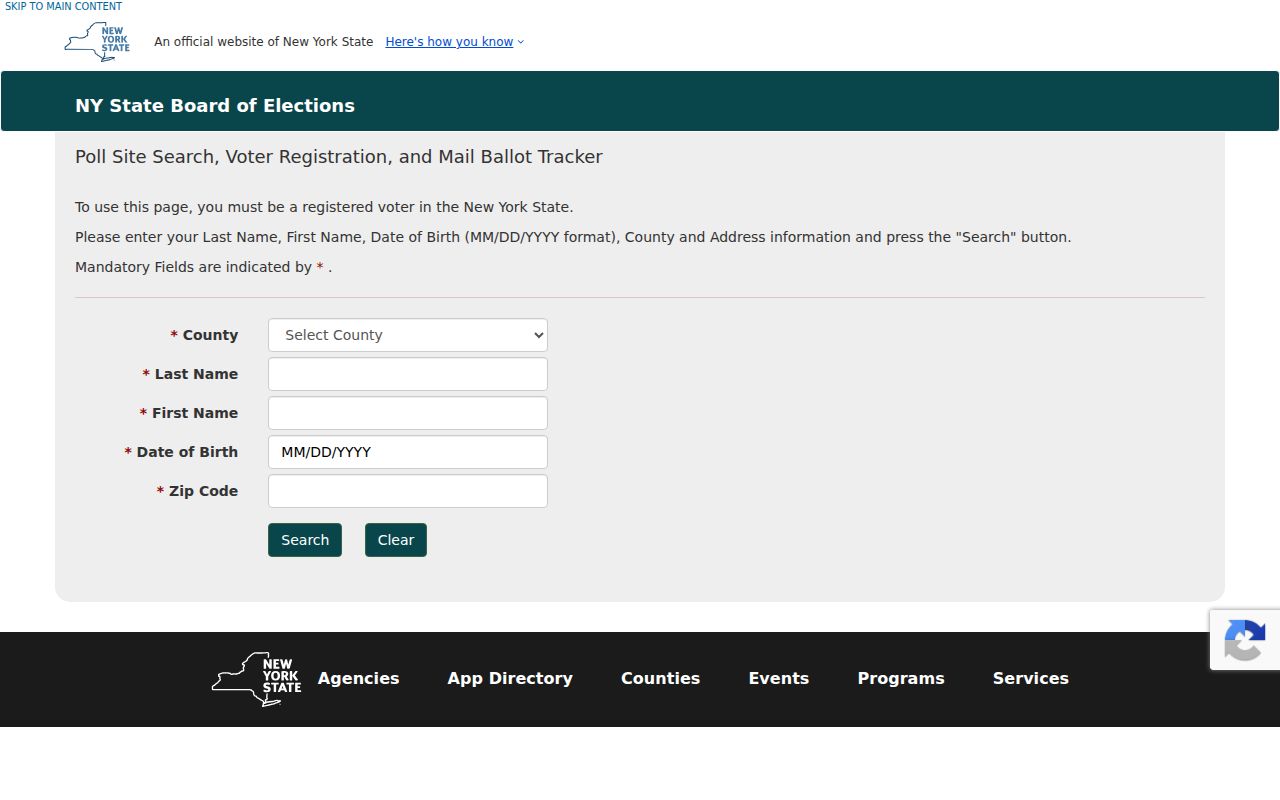
For a Town of Ithaca resident lookup, those required fields explain the tool's design. It verifies one person at a time. No ZIP-wide resident list comes out of it. Note: The BOE's August 2026 office move makes the current Board of Elections page safer than an older printed form.
Town of Ithaca Court Lookups
The Town of Ithaca Justice Court handles its own traffic, small-claims, civil, and criminal matters locally. It is not the City of Ithaca Court. Broader name research may call for the right NY eCourts path. WebCivil Local offers index, party, attorney or firm, and judge searches. WebCriminal works from a case identifier or defendant name plus selected court or calendar controls. NYSCEF accepts a case identifier, party, county, case type, and date range. It also takes Tax Cert or SCAR block-lot fields. WebSurrogate adds party, date-of-birth, file-number, old-index, index-book, and will routes. Use the court with jurisdiction over the event. Town Court is no proxy for City, County, Supreme, Surrogate, or federal cases. A public case row identifies a party role, not a current Town address. WebCivil covers local civil information only. WebCriminal runs on update delays. Federal matters go through PACER after registration. Sealed, juvenile, youthful-offender, adoption, family, Article 81, delayed-entry, and expunged matters can be omitted. Some may be restricted entirely. Tompkins publishes no live sample docket. So treat the fields below as a verification checklist rather than a known result.
| Case or index number | Unique court identifier to copy exactly when displayed. |
|---|---|
| Court, county, and case type | Shows the tribunal and matter category, not a residence claim. |
| Party and role | Keep labels such as plaintiff, respondent, petitioner, fiduciary, or counsel. |
| Dates and status | Filing, appearance, and disposition fields only when the system displays them. |
| Documents and redactions | Check access limits, image availability, and redacted material with the clerk. |
Verify a Town of Ithaca Resident
Normalize the name before anything else. Keep middle initials, prior surnames, spelling variants, and the exact municipality clearly separate. Then require two independent record types. Add at least one second discriminator, such as a spouse or kin relationship, an approximate age, a parcel, a dated address, a professional role, or a court role. Two records sharing only a name should never be merged.
- Verify whether the address is in the Town through the official address verifier, and retain the normalized municipal result.
- Use the County parcel or assessment route for the dated situs, owner, and mailing-address relation. Do not call an owner the occupant.
- Check the land index, voter lookup, court metadata, or history source only for the role and date each record provides.
- Compare a second discriminator and keep a contradiction log for moves, name changes, corporate addresses, or City/Town mismatch.
- When a record needs formal proof, request it from the named custodian instead of filling gaps from a name match.
- Docket
- A court’s numbered case record, which can list a case, parties, dates, and status where access is permitted.
- Index and image
- An index points to a record. An image is the underlying filed page when public access rules allow it.
- Certified copy
- A copy issued and authenticated by the custodian. It is different from a search result or ordinary printout.
A historical directory entry works only as a dated listing. The Town of Ithaca city directories cover the local 1864-to-1986 run and explain why an Ithaca-area entry still needs a Town boundary check.
Town of Ithaca Records Requests
A missing Town record is not the end of the road. New York's Freedom of Information Law, Public Officers Law Article 6, §§84–90, gives every requester a defined route. The Town Clerk manages records and handles FOIL. The Town public-records page offers OpenGov, email, or a verbal request, and it links the Laserfiche repository. Describe the record clearly. Name the property or topic. Give a date range. Ask for electronic copies when that suits you. A Town permit or board record belongs with the Town itself. The City office that shares the Ithaca name is not the right place for it.
FOIL normally forces an agency to grant, deny, or acknowledge a request inside five business days. Inspection and search cost nothing. Paper copies cap at 25 cents per page up to 9 by 14 inches. Actual-cost rules apply for unusual media. A precise address, record type, and date range will get you further than a broad fishing ask.
[INSIDER TIP] The Town OpenGov permit search returns basic project details and some documents. But records created before 2022 generally lack public documents. An empty document area is not proof that nothing exists. Keep the verified situs and use the Town FOIL route for a missing permit, certificate, or inspection record.
For the OpenGov and repository paths, the Town public-records source shows both routes. The FOIL page presents them side by side.
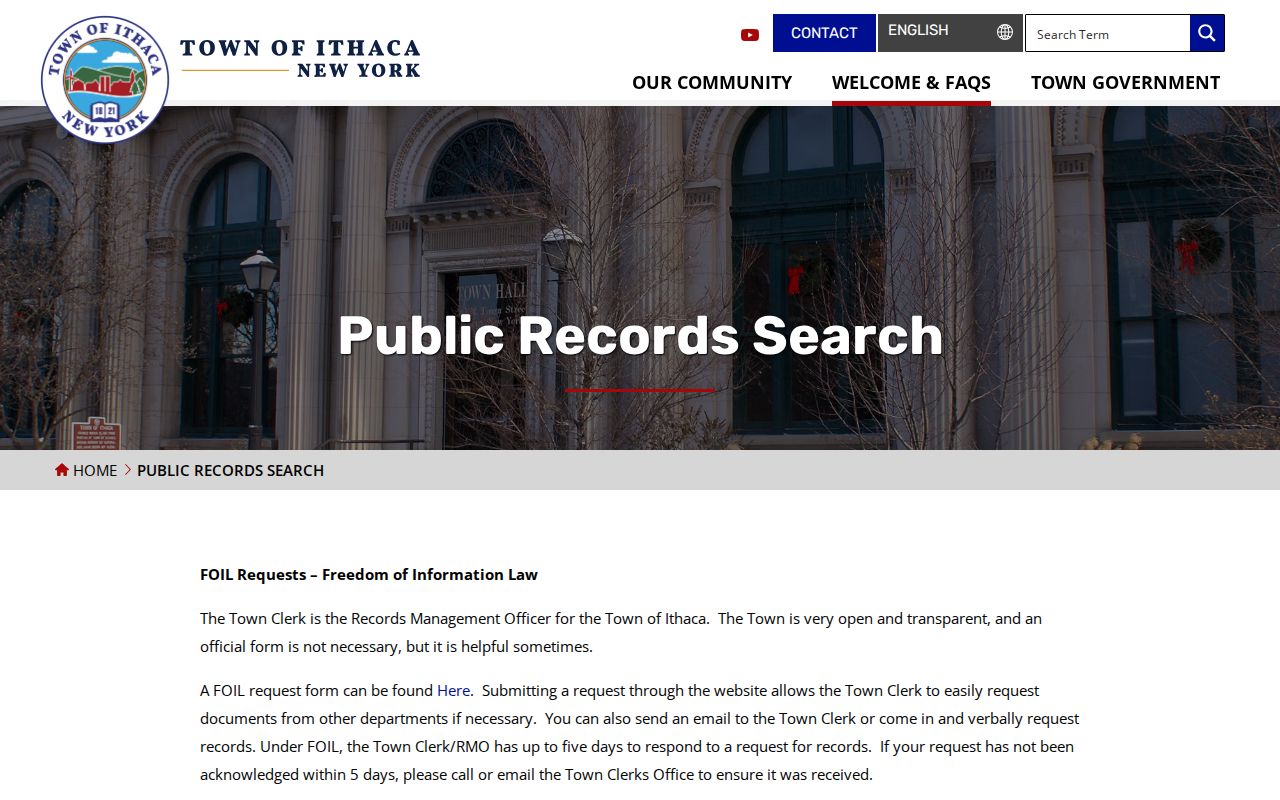
The image reflects a narrow Town of Ithaca records request once the online index comes up empty, and access still depends on statutory exemptions.
Town of Ithaca Vital Records
Vital records are not a public name-search shortcut. The New York State genealogy route generally opens birth records after 75 years when the person is known deceased. Death or marriage records open after 50 years when relevant people are known deceased. Direct-line exceptions exist, but they require stated proof. Outside New York City, registration began with deaths in 1880 and births and marriages in 1881. Certified copies, genealogy copies, indexes, and court files are separate products with separate rules.
Tompkins Whole Health registers births and deaths for qualifying county events. It posts local copy, correction, and genealogy routes. It holds birth certificates for people born in Tompkins County. It holds death certificates for deaths in the County. Its page gives a four-to-six-month genealogy estimate. The statewide page warns that processing can run eight months or longer. A marriage license stays where it was purchased. Divorce certificates from 1963 have a state route, but the underlying court file follows court-access rules.
Adoption questions from eligible people go to the NYS Adoption Information Registry. It serves eligible adult adoptees, qualifying birth parents, and biological siblings. Registration and documentation follow its own rules. It cannot locate an unregistered person. It also will not release sealed original records.
Note: No modern Town or County vital-index search exists online. Ordinary FOIL is not the route to vital records.
Town of Ithaca Lookup Results
A careful resident lookup labels every result. An assessment card can show an owner-of-record. It may also list a mailing address as of its roll date. A deed can name a grantee, grantor, lender, trust, or estate. A voter match supports a registration record, never ballot choices. A probate hit can identify an heir, fiduciary, petitioner, or creditor. A license or entity result points to a professional or service address. That is not a home situs. A directory, newspaper, or yearbook serves as historical evidence.
[MYTH] A deed party, owner, permit applicant, voter, business registrant, or directory occupant is not automatically the resident. Never assume a record names the current resident. Store the source URL, access date, municipality, role, and confidence level with each finding. When two sources conflict, keep both. Weigh a move, name change, postal mismatch, historic street change, or a different role. Then decide which record fits the person.
The County Clerk's January 2026 platform adds a free Property Fraud Alert. The alert gives notice of a filing for a selected name or property. It neither validates the document nor confirms an occupant. Confirm suspicious deed-related correspondence through the County Clerk's official contact.
Town of Ithaca Lookup Limits
New York shields several categories from ordinary lookup. The Address Confidentiality Program gives eligible survivors a substitute mailing address with forwarding, under Executive Law §108. Certain reproductive-health participants and providers qualify too. Protected-voter information and confidential addresses carry restrictions. Sealed court material, juvenile and adoption records, and DMV residence data each carry separate restrictions. Never try to rebuild an ACP participant's location from related records.
Send a correction to the right custodian. That is the office that created the record: County Assessment, County Clerk, Board of Elections, court clerk, licensing agency, or Town records officer. Commercial compilations can be stale, conflated, and hard to fix. Check an official custodian record for the role it actually establishes. A safety concern is a reason to stop the search, not widen it.
Lawful use. A Town of Ithaca resident lookup is for personal, lawful research. Never use a public record to stalk, harass, intimidate, or expose a protected person.